

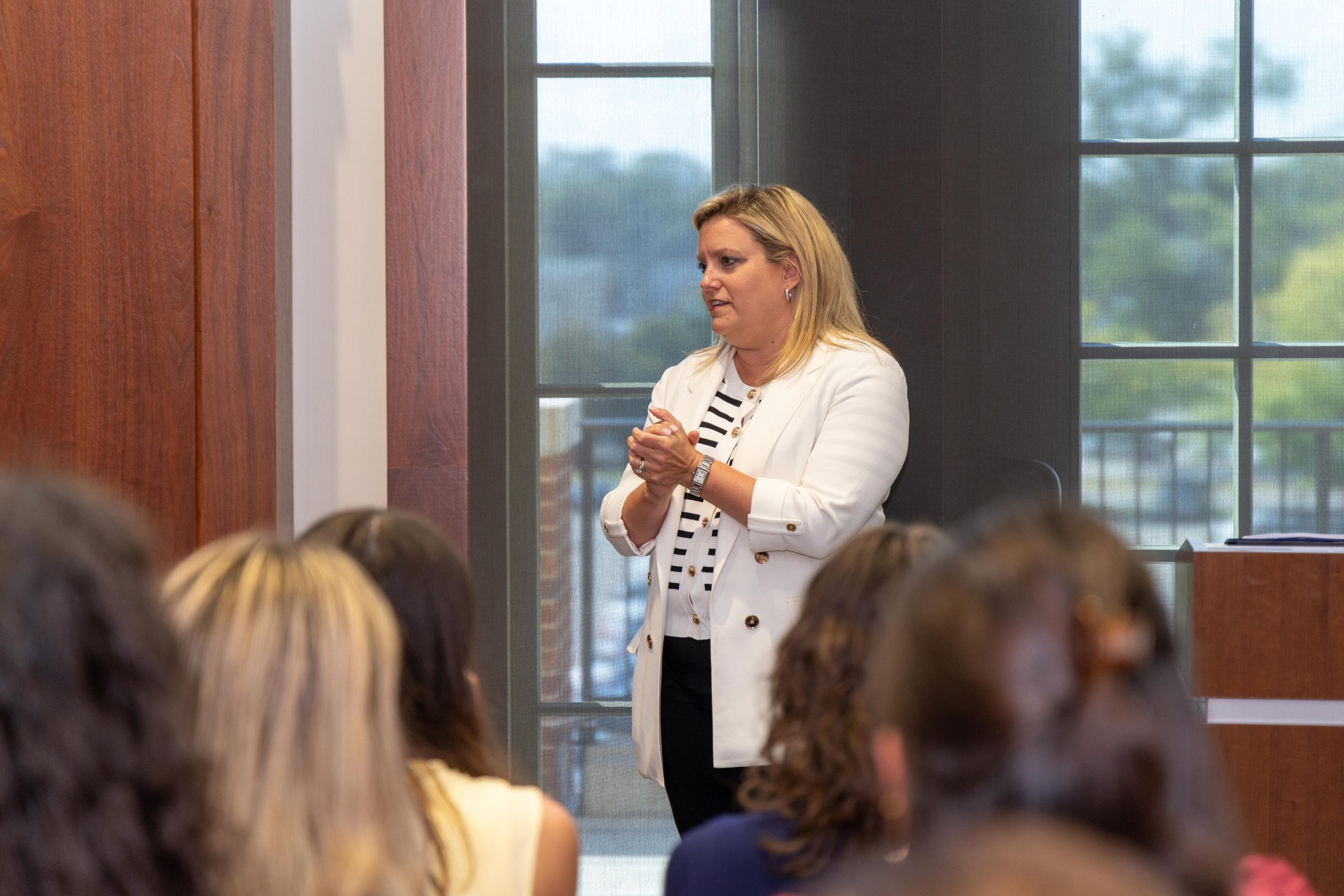
The banking industry is very different from the one Ashley Regner entered three decades ago. Artificial intelligence and data analytics are reshaping how banks operate, and the tools students learn today could be obsolete by the time they graduate.
However, Regner sees it as an opportunity for today’s Culverhouse College of Business students to lead. Regner, executive vice president and chief data officer at Wells Fargo spoke at a recent Lowder Lecture Series event and told students they are entering a business that is being rebuilt and that they will have a hand in deciding what comes next. The technology and jobs will change, but the people who know how to think, lead, connect with others, and embrace change will still matter.
“I hope that in the future, you guys are going to create the new landscape instead of walking into one that you’re going to transform,” Regner said. “You guys are such a powerful force of innovation and industry. You can create the future.”
Here is some advice Regner gave from her Lowder Lecture discussion to Culverhouse students.
Invest in learning new things
Regner encouraged students to say yes to experiences early in their careers, even when the work seems mundane or unrelated to where they eventually want to go.
As an accounting intern in the late 1990s she was paid $25 an hour to sit beside a fax machine and send documents. It was a boring and repetitive assignment, but she started reading the accounting materials she was sending.
Those documents helped her understand how businesses made financial decisions. A decade later, that experience paid off when she was leading accounting policy and writing impairment memos just like the ones she read as an intern.
“The goal of your first five years is to figure out what leaders you want to emulate, what leaders you never want to be like, and what type of work you receive,” she said.
As careers progress, Regner said, professionals should become more intentional about which opportunities they pursue.
“If you don’t have a strategy, you will fall for flattery,” she said, noting that titles, promotions and compensation can be tempting even when a job does not provide the experience someone needs.
Be relentless about gaining perspective
Regner said perspective allows professionals to see situations from different angles and recognize challenges before they become obvious.
She learned that while working at Regions in Birmingham, where she spent nearly a decade. A mentor told her if she wanted to reach her career goals, she needed to work outside Alabama. Regner followed the advice and the move exposed her to different cultures, teams, and ways of working, including the differences between U.S.-based and global organizations.
“Perspective is what allows you to connect the dots that others don’t see,” she said.
Lead with empathy and authenticity
Effective leadership begins with understanding why you are doing the work. Regner encouraged students to consider what they are passionate about, what difference they want to make, and how they want to affect the world around them. Understanding that purpose makes it easier to connect with others and lead authentically.
“Empathy is what makes people want to follow you,” she said. “And authenticity is what makes them trust you.”
Those qualities, she said, can make work more meaningful while helping leaders build stronger relationships with their teams.
Life is not about success but learning about others
Regner’s final lesson shifted the focus from individual achievement to relationships. Some of the most meaningful parts of her career were when she led consulting work, helping thousands of young people discover their purpose and become better leaders.
She encouraged students to seek out rooms where they can learn from people around them rather than always trying to be the most knowledgeable person in the room. That mindset also changes how students approach teamwork. Instead of viewing a group project solely as a competition for a higher grade, Regner said students should ask what they can learn from their teammates and how they can make the team stronger.
Her own leadership team is made up of people she believes could eventually lead major companies. What makes the group effective is not simply individual talent, but a shared purpose and a belief in what they are trying to accomplish together.
About Ashley Regner
- Executive Vice President and Chief Data Officer at Wells Fargo, where she leads a global team of more than 1,500 professionals and oversees enterprise-wide data governance, analytics, modern data platforms, and AI strategy.
- She is responsible for driving Wells Fargo’s transformation into a data‑centric organization, ensuring data quality, privacy, security, and regulatory compliance across more than 10,000 enterprise data associates. She partners closely with senior executives and the Board of Directors to advance the bank’s data strategy and enterprise AI programs.
- Prior to Wells Fargo, Regner served in several senior executive roles at Truist Bank, including Chief Information Risk Officer, Chief Technology Officer, and the Head of Technology Integration and Performance. Earlier in her career, she was a Consulting Partner at Ernst & Young LLP and oversaw transformation programs for many of the world’s largest financial institutions. She also held senior leadership roles at Regions Financial Corporation across Finance, Corporate Treasury, Risk, and Internal Audit.
- Graduate of The University of Alabama, where she earned her Bachelor of Science in Accounting, followed by her Master of Accountancy. She continues to serve the University as a member of the Culverhouse College of Business Board of Visitors and as the founder of the Ashley C. Regner Change the World Endowed Scholarship.
- Throughout her nearly 30‑year career, Regner has been recognized for her leadership, earning multiple EY Partner Impact Awards, the EY Chairman Award, and numerous honors for developing high‑performing teams and advancing women in leadership. She remains deeply committed to community service, supporting various organizations across Alabama, Texas, and North Carolina.