

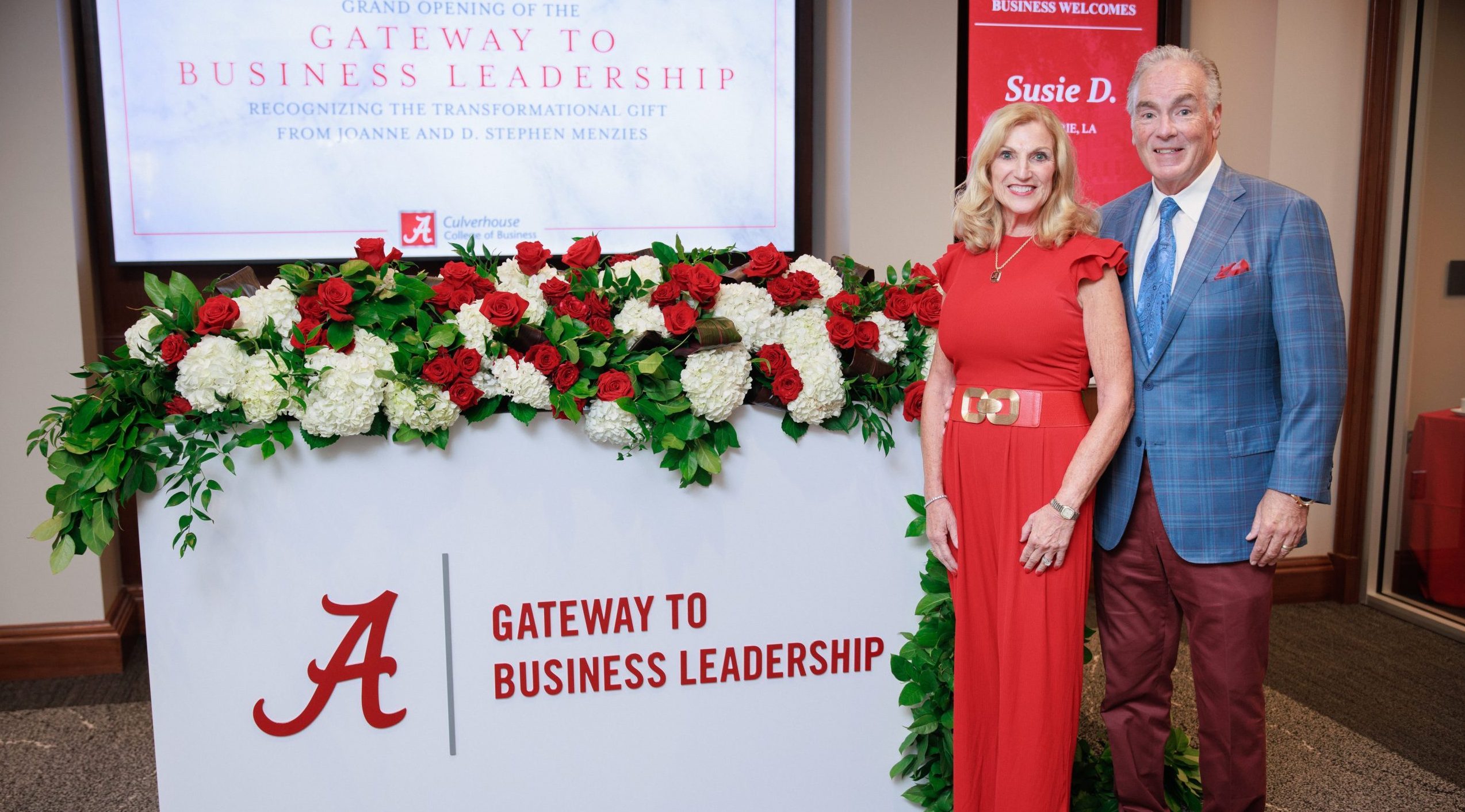
Stephen Menzies always had a sense of curiosity, a desire to learn and a willingness to think about what is possible. Those traits were encouraged by his advisor and mentor, professor of finance and banking Dr. Terry Martell, who introduced Menzies to interest-rate futures hedging while he was a graduate student at The University of Alabama.
After graduation, Martell continued to encourage Menzies’ learning, even arranging access to financial libraries at Chicago Board of Trade and Chicago Mercantile Exchange. Menzies immersed himself in the subject and eventually wrote a white paper for U.S. Gypsum. His idea ultimately reached the company’s CFO, who, over a private lunch, explained why Menzies’ thesis wouldn’t work. It was a disappointment for sure, but Menzies gained something valuable from the experience.
“I had established myself in the company as a young person who was thinking beyond their specific job responsibilities,” Menzies said. “I think back to Dr. Martell encouraging me to continue learning and facilitating that learning even while he was still teaching in Tuscaloosa and I had returned to Chicago. That learning really set a very good benchmark for me as someone who could be a lifelong learner and someone who was willing to think beyond today and to think about what might be possible.”
The experience became an early lesson Menzies carried throughout a successful career in capital equipment and organization. An opportunity is only the beginning. What comes next depends on what a person does with it. Decades after he first walked into Bidgood Hall as a graduate student, Menzies is helping create those opportunities for the next generation of Culverhouse students.
Menzies’ major gift to the Culverhouse College of Business made possible the Gateway to Business Leadership, a renovated entry to Bidgood Hall designed to help students turn what they learn in the classroom into the skills they need beyond it. At its center is a dedicated space for student development through the Kelly LEAD program, where staff and student coaches lead dozens of small group workshops each week focused on professional skills such as collaboration, conflict resolution, and time management. Students can practice interviewing, receive feedback on their elevator pitches and develop the confidence to navigate the professional world.
The mission resonates with Menzies because of his own Alabama experience. He graduated from Tulane University with a business degree and wanted to specialize in finance. He initially applied to Alabama’s business and law schools as part of a joint program. He was accepted by the business school but not admitted to the law school.
However, Culverhouse offered him the program, curriculum, and access to faculty he desired. Menzies expresses gratitude for Dr. Hazel Ezell, Dean of the College of Commerce at the time, for giving him life-determining opportunity. He remembers walking into Bidgood Hall in February 1977 to meet with Dr. Ezell and realizing that the next step was his to take.
“I knew that it was time for me to take control of my future, that the opportunities had been presented for me,” he said.
That philosophy has shaped both his career and his philanthropy with his wife, Joanne. The couple’s giving has focused on creating opportunities for young people, from scholarships and athletics to development programs and now the Gateway to Business Leadership.
“Joanne and I have been very focused in our philanthropy to support programs and investments and creating opportunities for development of young people,” Menzies said. “Let’s make sure the doors are open. Let’s make sure young people have opportunities to go through those doors, to grow, develop, lead, and contribute to our community. Once you’re through those doors, it’s up to you to be intentional about your development and about what you do.”
Menzies’ career was built around that same idea. He describes himself not as someone who mapped out every step, but as someone who prepared for opportunities and deliberately pursued them. “Luck is where preparation and opportunity meet.”
Preparation, he believes, is especially important for young professionals entering the workforce. A college degree demonstrates that a graduate is “educatable and trainable,” he tells students, but it does not mean they are finished learning. Employers will continue to train them, develop them and teach them how to apply what they learned in college. The responsibility, he says, ultimately belongs to the individual.
“It’s all intentional,” Menzies said. “It’s up to you. You’ve been given the opportunity, you’ve been positioned for success, you’ve been given the tools. What will you do?”
That is the lesson Menzies learned from Martell, from his own early career and from the moments when things did not go according to plan. The white paper did not produce the result he envisioned. Instead, it demonstrated his willingness to learn, take initiative and think as a leader. That distinction helped him stand out at U.S. Gypsum and put him on a successful track of accomplishment and leadership.