

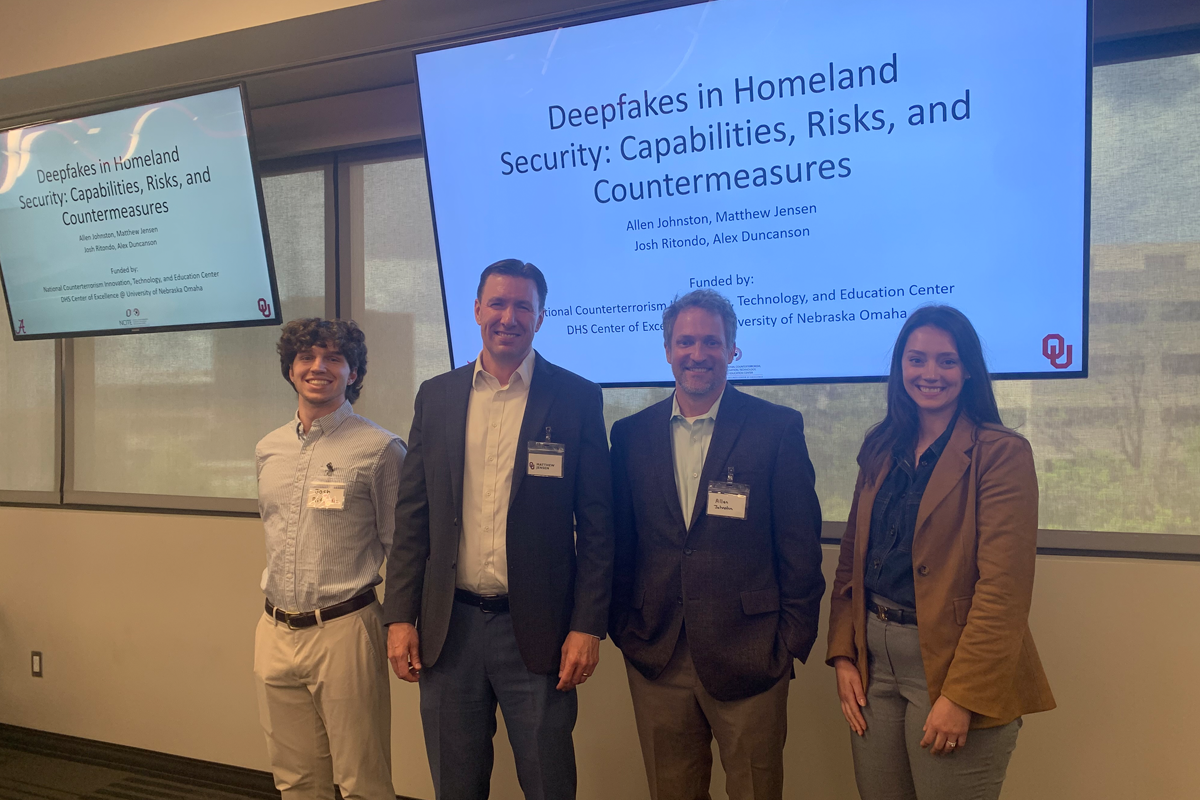
From deepfake scams to virtual reality digital twins, National Counterterrorism Innovation, Technology, and Education Center (NCITE) researchers are helping practitioners understand how emerging AI technologies can be used – and misused.
This spring, NCITE consortium members based at The University of Alabama, the University of Oklahoma, and Penn State University conducted a series of immersive workshops with critical infrastructure, national security, and public safety practitioners to help them understand the risks, prevention tools, and procedures to handle emerging AI. Artificial intelligence is no longer confined to chatbots and text generators. Today, it can clone voices, create convincing fake videos, and build immersive virtual replicas of real-world environments – capabilities that are creating new opportunities and new security challenges.
Dr. Allen Johnston of Culverhouse, along with colleagues from the University of Oklahoma, led a nearly seven-hour workshop on deepfake technologies with security practitioners that combined teaching, demonstrations, hands-on exercises, and guided discussions. Participants learned how deepfake audio and video are created, how detection technologies work, and how organizations can incorporate mitigation practices into investigative and intelligence workflows.