

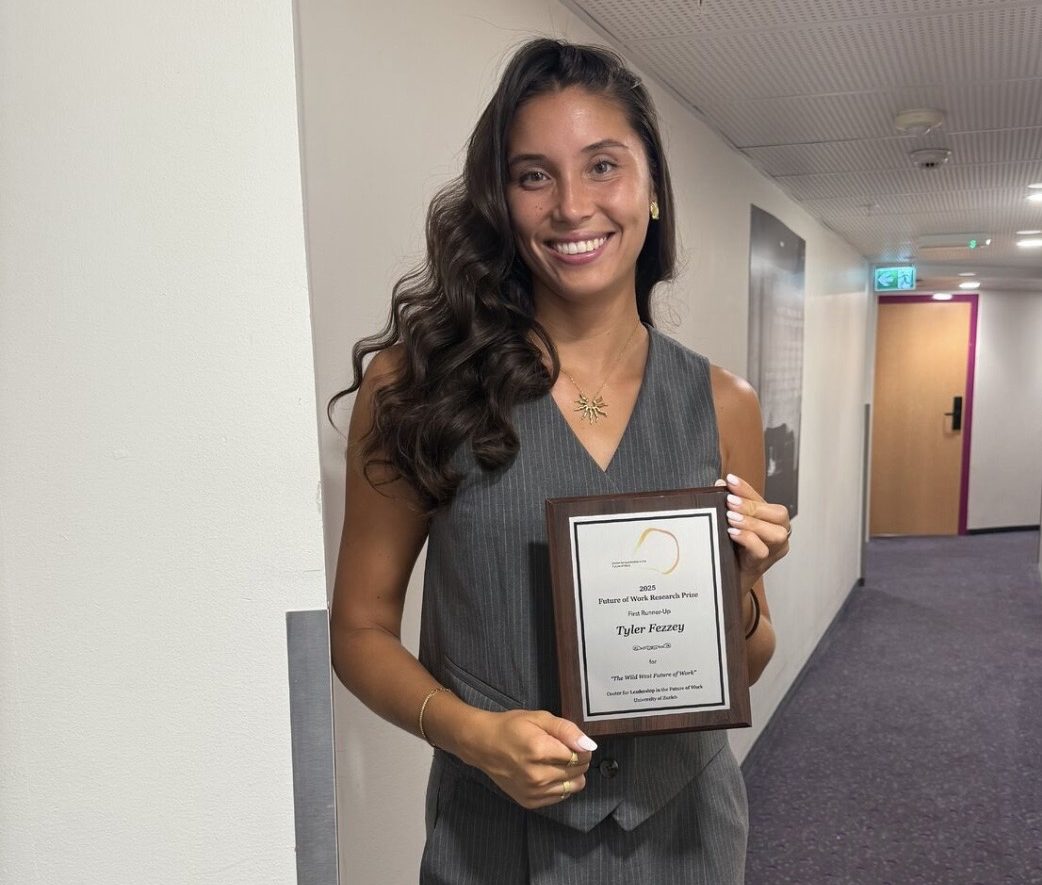
“I’m endlessly excited about what I’ll continue to pursue in my career,” said Tyler Fezzey, a current doctoral candidate in management at the Culverhouse College of Business. Fezzey was recently named the recipient of The University of Alabama’s Graduate School Premier Award, which “honors a graduate student whose University of Alabama experience encapsulates the University’s tripartite mission of teaching, research, and service.”
Before arriving at The University of Alabama, she earned her MBA with Highest Honors from the University of West Florida, where she was selected as the commencement speaker and named the Lewis Bear Jr. College of Business Graduate Assistant of the Year. She previously completed her bachelor’s degree in finance at Cal State Fullerton in just three years, graduating summa cum laude.
Throughout her education, Fezzey has consistently embraced rigorous scholarship — a commitment evident in her rapidly growing research portfolio, which centers on interpersonal competition, subclinical personality traits, leadership, and gender bias. Her work already appears in respected journals, including the Journal of Business Research, Journal of Occupational and Organizational Psychology, Organizational Research Methods, and Group and Organization Management.
With a record of scholarship that bridges theory and practical relevance, Fezzey is uniquely positioned to speak to the complexities of competitiveness, personality, and leadership. The discussion below explores how her personal experiences, academic training, and research insights come together to inform her work. What follows is our conversation, conducted over email.
First, an easy one. How does it feel to be the recipient of the Graduate School Premier Award? How did you find out you were the recipient?
I’m ecstatic to be the recipient of the award this year. I found out in January when Dr. Steven Hood gave me a phone call one Friday, and it definitely set the tone for a great last semester of graduate school! It was an honor to be at the acceptance banquet alongside other campus-wide award winners, deans, and prestigious scholars.
Your research work spans competitiveness, dark personality traits, and leadership. What overarching questions or themes tie these interests together for you, and what fascinates you most about their intersection?
I think competitiveness has preoccupied my research since I started graduate school because I was a collegiate student athlete, and it’s always been a part of my identity to try to win in anything I do — athletics, academics, awards, even friendly games of pickleball are relentlessly competitive in my family. I saw how that personality trait had pushed me to great heights in my life, but also led to some downsides, wherein I could be aggressive with others or too difficult on myself. That naturally led me to study dark traits and behaviors and to try to understand why people misbehave. Leadership became a natural context to explore these dispositions because it’s where dark traits and behaviors can be most destructive: when someone has explicit power over others, something that might seem a quirk of character at first can become quite destructive to organizations and individuals alike. So can being overly competitive. Having a bottom-line mentality, for example, can significantly harm workplace dynamics and organizational commitment and lead to turnover of talent that companies need to retain. I think that intersection is not only interesting but highly consequential. Some surveys report that 70% of people’s least favorite part of their job is their boss. Wouldn’t it be amazing if we could fix that?
What practical implications do you hope your research on competitiveness and well‑being will have for organizations or leaders?
My goal would be that we come to broadly recognize how competitiveness needs to be directed and tempered at work. My dissertation finds that competitive people perform better, tend to ascend into leadership, are more committed, resilient, and self-confident, which is what we want in workers. However, they also have a higher tendency toward workplace deviance, risk-taking, aggression, and dark triad traits (e.g., narcissism). Given this, I think we need to inform organizations that hiring on competitiveness is an excellent idea for performance, but these individuals need to be told where to direct their competitiveness so they don’t lash out against coworkers and subordinates. Competitive people are winners and high-achievers at work, but they need to be taught to direct that energy toward competitors or benchmarks rather than each other. I think better leadership and teamwork will follow, and it’s my hope that getting my research out there will make that a norm.
You’ve taken on many leadership and service roles during your doctoral program. How has that involvement influenced your development as a scholar?
It has been one of the most important pieces of my scholarly development. No one should make recommendations about leadership without a chance to experience what it’s really like first-hand. I don’t think in as privileged a role as university scholars we should avoid giving back. In my acceptance speech for this award on Thursday, I stated that research might be how you make a name in our field, but that name doesn’t matter unless it’s attached to a pair of helping hands, and I think that’s why I’ve been able to be impactful in my work. I focus on serving first. Research has a lagging impact as it slowly disseminates, but I can make powerful impacts immediately by giving back, serving, and leading.
As you look ahead to the next phase of your research and career, what questions or projects are you most excited to pursue?
I’m endlessly excited about what I’ll continue to pursue in my career. At every conference, I’m introduced to new constructs and streams of thought, and meeting coauthors at these events has continued to lead me into novel, high-impact research areas. Right now, I have three active grants I am working on, one of which centers on reducing gender inequities at work by investigating Queen Bee Syndrome, a term used to describe the phenomenon of women leaders actively attempting to block other women from leadership, despite the understanding that women are often already at a disadvantage in reaching leadership positions. That work is probably what I’m most invested in and excited about right now, and I’m thrilled to see what I can uncover to ensure that behavior eventually ceases.
Finally, what learnings have you gained from working with the faculty here at Culverhouse? Anything specific that you’d like to share?
I was honored to learn research methods in particular from both Dr. Peter Harms and Dr. Justin DeSimone. I would not be able to produce research at the rate I do if I had not been well-trained. Without strong methods training, I do not think you can call yourself a researcher, and Dr. DeSimone ensured we truly understood the mathematics and statistical assumptions behind the methods we employ. Dr. Harms instilled the importance of research ethics and proper techniques, and I am all the better for having had the chance to learn from them. Dr. James King has been a close mentor of mine since I joined UA. I ran some of my earlier research ideas by him in my first semester when I was still relatively unaware of the work needed to bring new projects off the ground, but he would have lunch with me, listen, and provide necessary feedback to adjust my ideas. These three, alongside Drs. Ron Dulek, Michael Ford, Maura Mills, Paul Drnevich, and Jef Naidoo, have been essential for my development at UA.